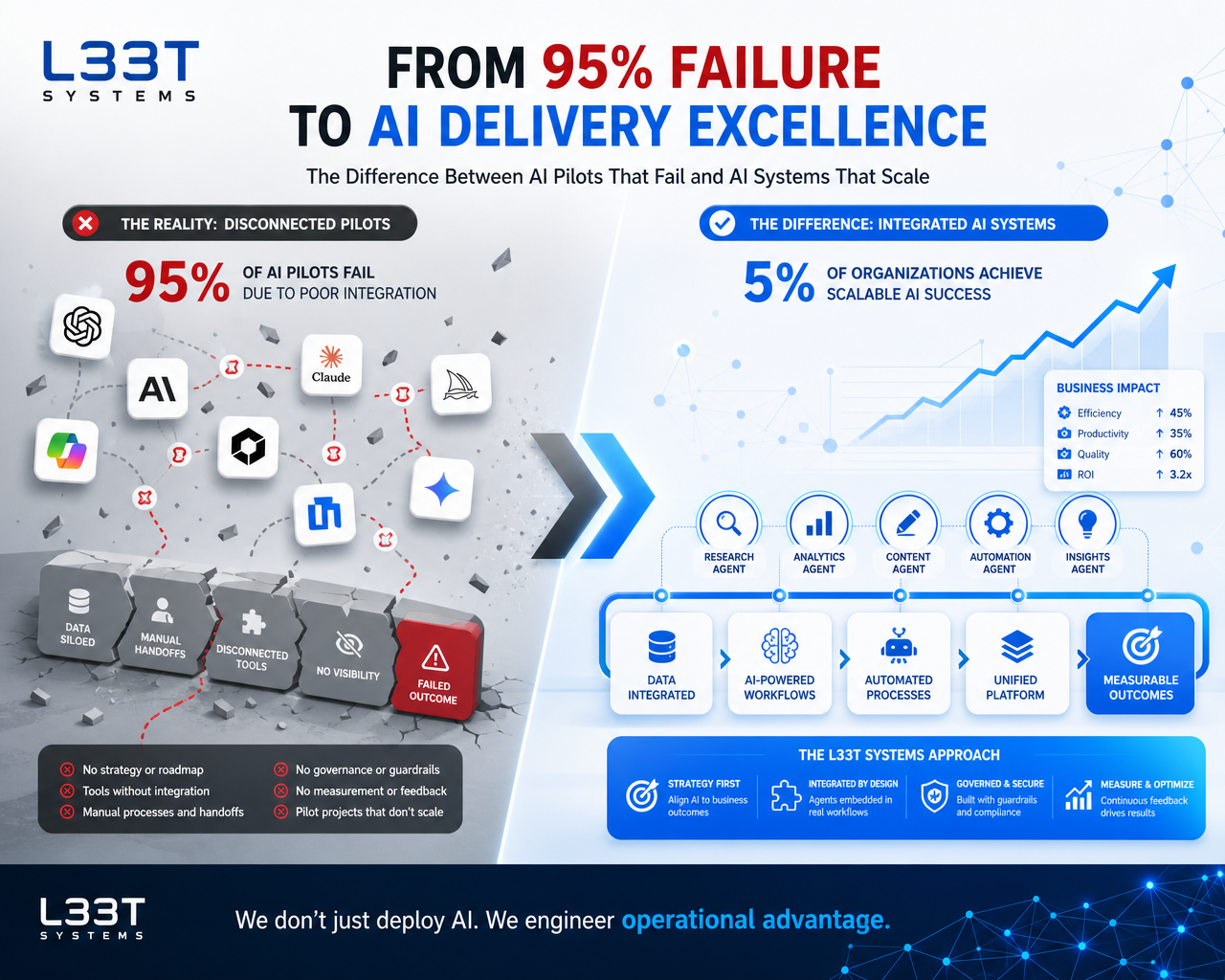
Why Your Engineering Team's AI Strategy Shouldn't Look Like Everyone Else's
The Copy-Paste AI Strategy Problem
Every week, another case study emerges about how Company X increased productivity by 40% using AI tool Y. Engineering teams and professional services firms read these stories, buy the same tools, and expect similar results.
Six months later, they're disappointed. The AI tools that transformed another company's workflow barely move the needle for their team. Sometimes they even slow things down.
Why Context Matters More Than Technology
Two development teams can use identical AI coding assistants and get completely different results. The difference isn't in the technology; it's in how the tool fits their specific workflows, team structures, and client requirements.
Team A works on greenfield projects with flexible timelines and minimal legacy code constraints. Their AI coding assistant accelerates feature development and helps junior developers learn faster.
Team B maintains enterprise applications with strict compliance requirements and extensive existing codebases. The same AI tool creates integration headaches and introduces potential security risks that slow down their delivery pipeline.
Your Delivery Model Is Your Competitive Advantage
Professional services success comes from solving client problems efficiently while maintaining quality and building relationships. Your specific approach to achieving these outcomes is what differentiates you from competitors.
Generic AI strategies ignore these differentiators. They assume all engineering teams have similar workflows, skill distributions, and client expectations.
Smart AI integration preserves what makes your delivery model effective while accelerating the parts that create bottlenecks.
The Four Factors That Shape AI Integration Success
Team composition and skill distribution. A team with mostly senior developers has different AI needs than a team training junior talent. The AI tools that help experienced developers work faster might overwhelm new team members.
Client engagement models. Fixed-bid projects require different AI approaches than time-and-materials engagements. What works for internal product development might not work for client services.
Technical constraints and requirements. Compliance requirements, legacy system integrations, and security protocols all influence which AI tools can be safely deployed and how.
Delivery methodology and processes. Agile teams need AI tools that integrate with sprint planning and daily standups. Waterfall projects require AI that supports upfront planning and documentation.
Beyond Tool Selection: Integration Architecture
Successful AI integration isn't about choosing the right tools. It's about designing how AI capabilities connect with existing processes, team interactions, and client touchpoints.
This requires mapping current workflows to identify where AI can add value without disrupting what's already working. It means understanding the ripple effects of automation on team dynamics and client relationships.
Most importantly, it involves creating feedback loops that help teams learn and adapt their AI usage based on real delivery outcomes.
The Assessment Before the Strategy
Before selecting AI tools or planning integration approaches, successful teams conduct honest assessments of their current delivery capabilities. They identify bottlenecks, skill gaps, and process inefficiencies that AI could address.
They also evaluate their change management capabilities and team readiness for new workflows. AI integration fails when teams lack the foundational skills to adapt their processes around new capabilities.
Building Your Unique AI Advantage
The goal isn't to use AI like everyone else. It's to use AI in ways that make your specific delivery model faster, more reliable, and more valuable to clients.
L33t Systems' AI delivery audit helps engineering teams and professional services firms develop these customized integration strategies. We map your current workflows, assess your team capabilities, and identify AI opportunities that align with your delivery model and business objectives.
Stop trying to replicate someone else's AI success story. Start building an AI integration approach that amplifies what your team already does best.
L33t Systems AI delivery
AI-Augmented Delivery Audit — for engineering teams, agencies, and professional services firms designing how AI ag
Discover what we're building
Learn more about L33t Systems AI delivery and get started today.
Visit L33t Systems AI delivery