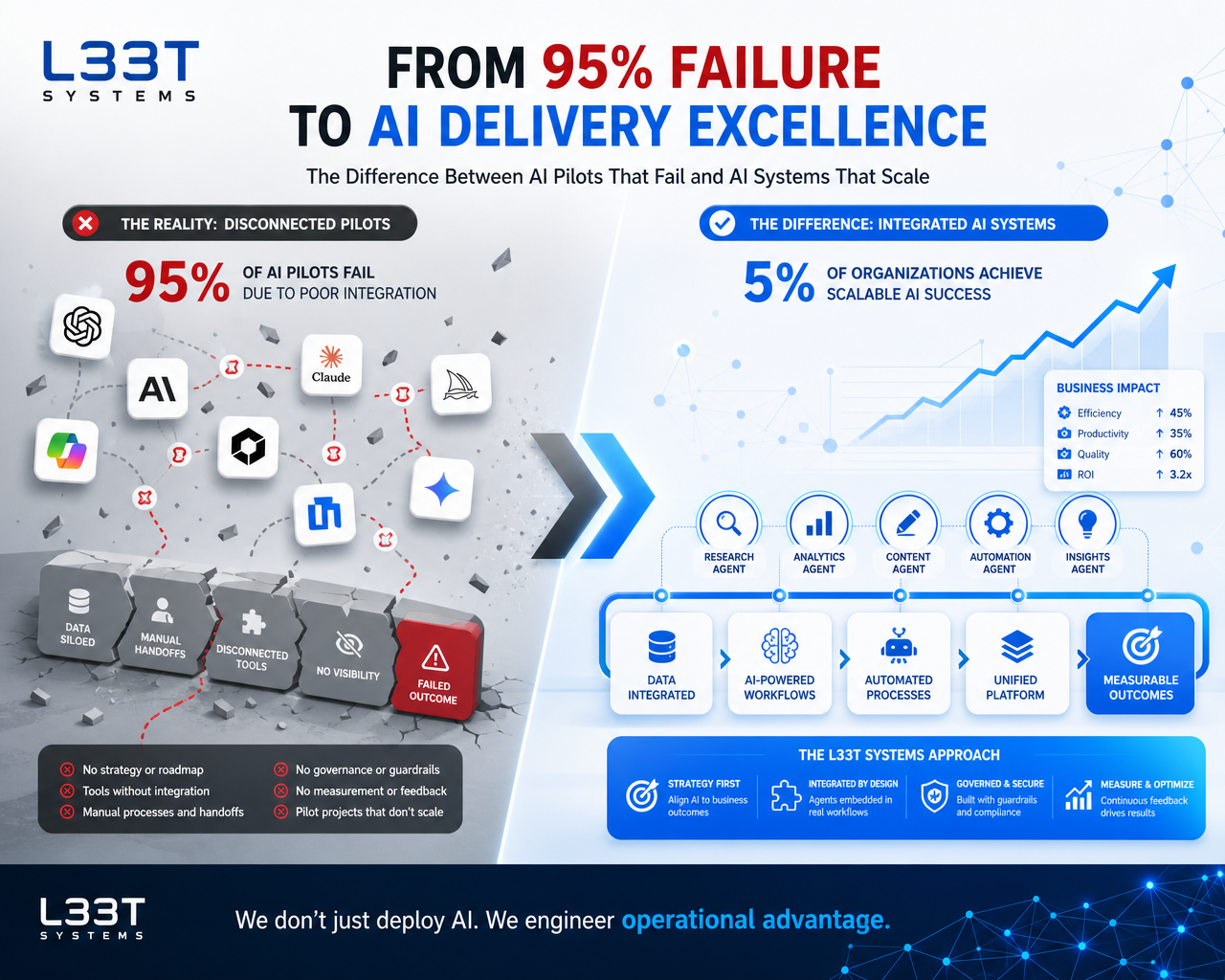
Why Most Professional Services Teams Are Wasting Money on AI Pilots That Go Nowhere
The AI Pilot Project Graveyard
Walk into any professional services firm right now and you'll find the same pattern. Engineering teams, agencies, and consultancies have spent months building AI prototypes that wow leadership in demos but never make it into actual client work.
The problem isn't technical capability. These teams can build chatbots, automate code reviews, and create AI assistants that sound impressive in presentations. But when it comes to integrating these tools into real delivery workflows, everything falls apart.
Three Signs Your AI Strategy Is Actually Just Expensive Theater
Your AI initiatives are stuck in pilot purgatory if you recognize these patterns:
You're building solutions without understanding the problem. Teams rush to implement the latest AI model without mapping where automation would actually improve delivery speed or quality.
Your pilots work in isolation but break in production. That code generation tool works great when developers use it alone, but creates chaos when integrated with existing peer review processes and client requirements.
You're measuring AI success by feature adoption, not business outcomes. Teams celebrate when 60% of developers use the new AI tool, but can't show whether projects are finishing faster or with fewer defects.
What Changes When You Think Delivery-First
Successful AI integration starts with a simple question: where in your current delivery process do bottlenecks actually cost time and money?
Take code reviews. Most teams assume AI can speed up code generation, so they focus on tools that write more code faster. But the real bottleneck isn't writing code; it's the three-day delay between code submission and review completion.
Smart teams deploy AI to triage pull requests, flag common issues, and pre-populate reviewer feedback. Same technology, completely different impact on delivery speed.
The Integration Reality Check
Before investing in another AI pilot, audit your current delivery workflows. Map the handoffs between team members. Identify where work sits waiting for human attention. Find the repetitive tasks that eat up senior talent's time.
Most professional services teams discover that their biggest AI opportunities aren't in the obvious places. Client communication, project scoping, and quality assurance often offer more immediate returns than code generation or design automation.
Moving Beyond Experiments
The teams winning with AI in 2026 aren't the ones with the most sophisticated models. They're the ones with the clearest understanding of where AI fits into their actual work.
This means evaluating team capabilities, assessing integration risks, and creating implementation roadmaps that won't disrupt existing client relationships. It means treating AI as a delivery optimization tool, not a technology experiment.
L33t Systems' AI delivery audit helps professional services teams make this transition. We map current workflows, identify high-impact integration opportunities, and create actionable implementation plans that turn AI experiments into measurable delivery improvements.
Stop building impressive demos that never ship. Start building AI integrations that actually accelerate how you deliver value to clients.

L33t Systems AI delivery
AI-Augmented Delivery Audit — for engineering teams, agencies, and professional services firms designing how AI ag
Discover what we're building
Learn more about L33t Systems AI delivery and get started today.
Visit L33t Systems AI delivery