Why 95% of AI Pilots Fail in Professional Services
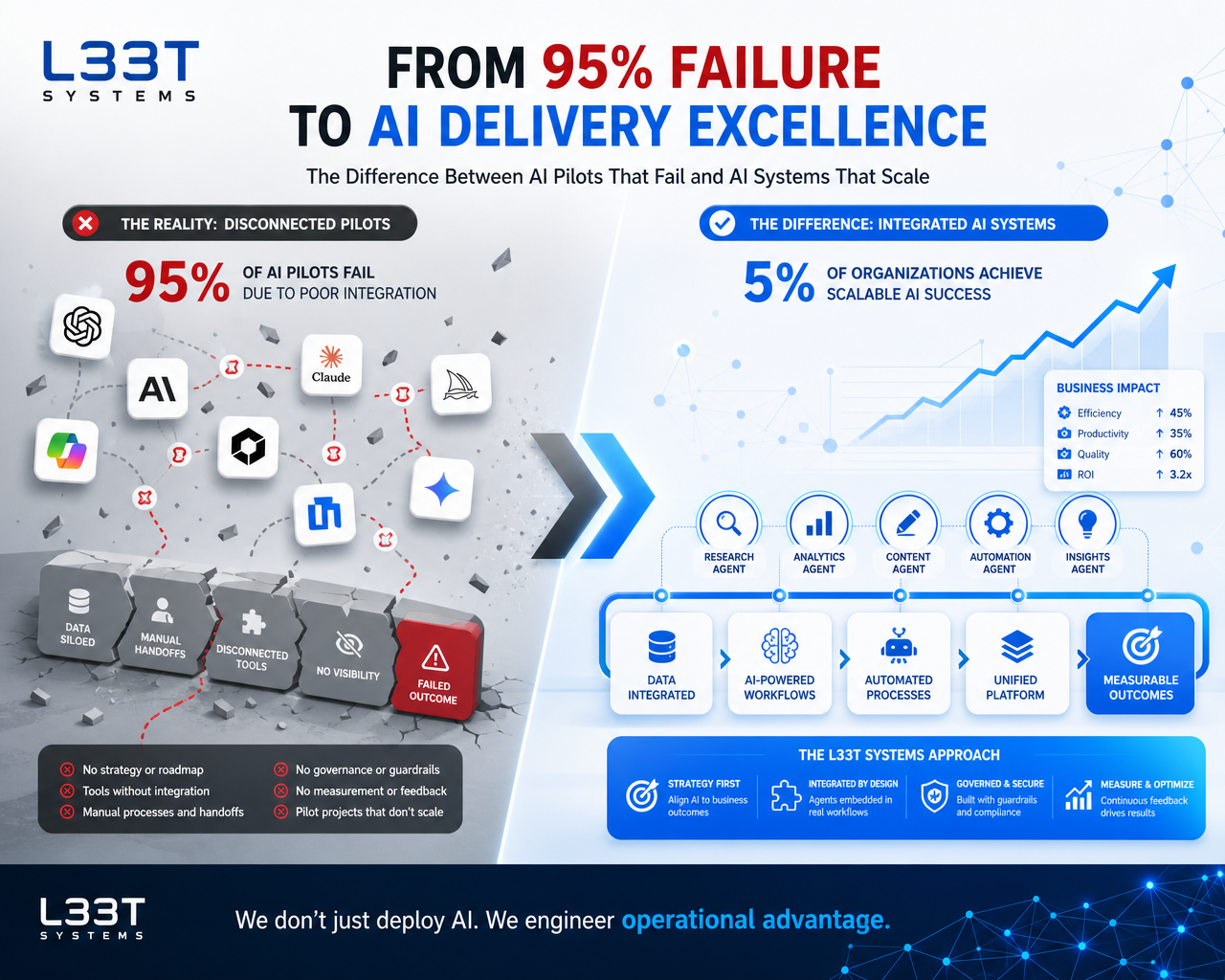
Why Many AI Pilots Fail in Professional Services
Your team demos an AI agent that can write contracts in minutes. It works flawlessly. Legal loves it. Finance sees dollar signs. Six months later, that same AI project sits in "pilot purgatory" with no production deployment date in sight.
Sound familiar?
According to recent industry surveys, a significant majority of generative AI pilots fail to deliver measurable return in professional services. These aren't outliers. They're the norm.
The problem isn't necessarily the technology. The failure is often in strategy, data readiness, and organizational change management — not in the AI itself.
The Pilot Purgatory Problem
Most professional services firms approach AI like a layer they can paint over existing workflows. Demo an AI writing tool. Show impressive speed gains. Get budget approval. Deploy horizontally across teams.
Then reality hits.
Generative AI projects are easy to test but much harder to scale effectively. Many companies launch pilots successfully but struggle to turn them into secure, useful, and measurable business solutions.
The AI works in the sandbox. But when it meets real client data, approval chains, and compliance requirements, everything breaks down. Many AI systems stall when organizations attempt to scale them into real operating environments, where data becomes inconsistent, dependencies multiply, and execution shifts from controlled testing to cross-functional ownership.
Why Deployment as a Horizontal Layer Fails
Here's what kills most AI pilots: treating AI as a universal productivity booster instead of understanding where it actually creates value.
Some high-performing organizations report success by fundamentally rebuilding their workflows around AI rather than layering AI on top of existing systems. It's not a productivity layer you apply to existing workflows but an operational framework you build around.
When you deploy AI horizontally across all workflows, you're asking one tool to solve completely different problems. Contract generation needs deterministic accuracy. Resource planning needs real-time data integration. Client reporting needs brand consistency.
Each workflow has different risk tolerances, data requirements, and success metrics. A horizontal deployment ignores these differences and creates the verification tax that kills ROI.
However, workflow redesign comes with significant challenges: it requires substantial change management, may disrupt established processes, and demands considerable upfront investment in training and system integration.
The Two Distinct AI Operations
Some successful professional services firms recognize that AI serves two fundamentally different operational domains:
Delivery AI: Client-facing work that requires human judgment. Contract review, strategic analysis, client presentations. These systems augment professional expertise but keep humans in the loop for all consequential decisions.
Management AI: Back-office operations that can run autonomously. Resource allocation, billing workflows, project tracking. These systems handle deterministic processes with clear success criteria.
Some leading enterprises are making a deliberate architectural choice across both domains. On the delivery side, they're investing in AI that equips practitioners with faster research, stronger synthesis, and better client output, with human judgment anchoring every consequential decision. On the management side, they're investing in AI agents that autonomously execute operational infrastructure.
Trying to use the same AI approach for both domains is like using a race car for grocery shopping. It might work, but you're optimizing for the wrong outcomes.
How Misdiagnosis Kills ROI
Most failed AI pilots share the same misdiagnosis pattern:
- Problem: Slow document review process
- Solution: Deploy AI writing assistant
- Reality: Documents still need legal review, client approval, version control
- Result: Minimal time savings, new verification overhead
Multiple industry research studies identify data quality as a major barrier to AI adoption. When the underlying data infrastructure is fragmented—when finance, delivery, and customer systems don't share a unified data model—AI has no solid foundation on which to operate. Organizations end up anchored in document-adjacent lightweight use cases rather than the operational workflows where the real value may lie.
The real constraint isn't document creation speed. It's workflow integration, approval cycles, and data consistency.
Organizations that skip defining measurable success metrics often find themselves unable to demonstrate value when budget reviews arrive.
The Importance of Operational Integration
The minority of AI projects that succeed don't just implement technology. They redesign operations.
This approach involves redesigning processes for AI rather than adding AI to existing workflows, which often leads to pilot failure.
This means:
- Data architecture first: Building unified data models before deploying AI
- Workflow redesign: Restructuring processes around AI capabilities, not bolting AI onto existing processes
- Success metrics: Defining measurable outcomes upfront, not hoping for productivity gains
- Change management: Training teams to work with AI, not just use AI tools
Some evidence suggests that purchasing AI tools from specialized vendors and building partnerships tend to succeed more often than internal builds. The successful deployments focus on deep workflow integration, not feature breadth.
Moving Beyond Pilot Purgatory
The path out of pilot purgatory isn't necessarily more advanced models or bigger budgets. It's operational discipline.
Successful AI projects tend to share three characteristics: they defined success upfront, they invested in their data foundation first, and they treated deployment as an organizational change, not a software launch.
Stop treating AI as experimental technology. Start evaluating where AI agents actually improve delivery outcomes. A systematic approach can turn guesswork into strategic advantage.
Your next AI project doesn't have to join the majority that fail. But only if you're willing to rebuild workflows instead of just adding AI tools.
Ready to turn your AI experiments into delivery excellence? Get a systematic evaluation of where AI agents fit into your delivery model. Learn more about our AI-Augmented Delivery Audit and discover approaches designed to improve delivery speed while reducing project risk.

L33t Systems AI delivery
AI-Augmented Delivery Audit — for engineering teams, agencies, and professional services firms designing how AI ag
Discover what we're building
Learn more about L33t Systems AI delivery and get started today.
Visit L33t Systems AI delivery